Skip to content

Every meaning names the tradition it comes from

A field guide to your own dreams and signs.

Write it down. Wake up to what it means.

Record a dream, a sign, or how the day actually went. Overnight, with nothing to press and nothing to wait for, Omenari reads each entry symbol by symbol, names the tradition every meaning comes from, and ties the day into a single thread by morning.

The first week is free. Your entries stay private by default.

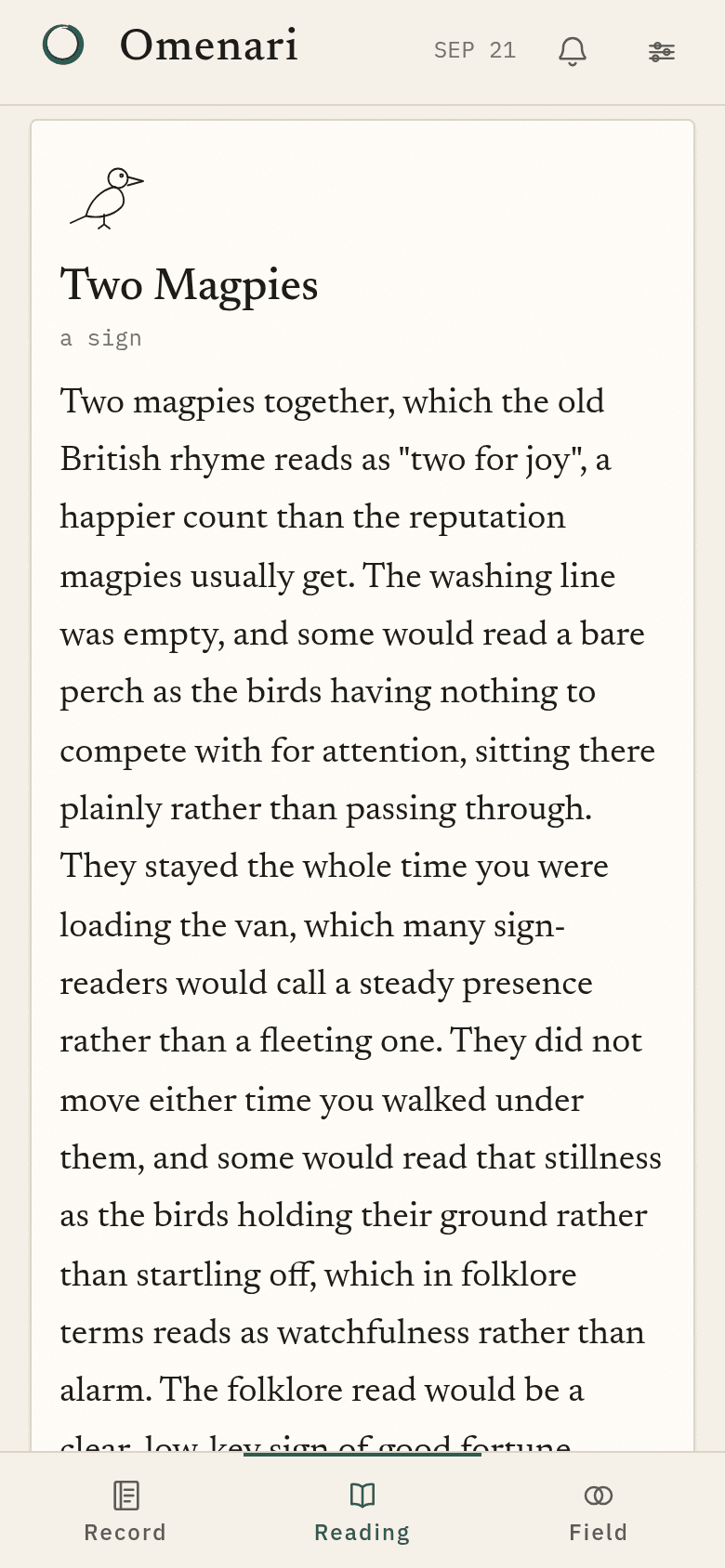
The Reading in Omenari: this week’s days, and reading cards each with a line-drawn plate and the tradition its meaning comes from.
Pl. IThe Reading

What comes back

You write. Omenari reads.

A reading

An entry in the evening. A reading by morning.

Each symbol is read on its own terms, with the tradition its meaning comes from named on the card. Tap the tradition in the app to read what it is.

Example

Three deer at the edge of the woods behind the office. They didn’t run.

British and Irish folklore

The deer is held to move between the settled world and the wild one, and to be seen at the boundary between them is read as a summons rather than a warning. Deer that stand their ground instead of bolting were taken as a sign that the crossing was being offered, not forced.

Written for this page. Your readings are written from your own entries.

How the night works

Nothing to press. Nothing to wait for.

  1. 01 · During the day

    You write

    A dream before it fades, a sign when you see it, a few lines on how the day actually went. Write it the way you’d say it.

    • DreamWhat visited you in sleep.
    • SignSomething the day showed you.
    • JournalHow it actually went.
  2. 02 · At 11:59 pm, your time

    It is read while you sleep

    Just before midnight in your own timezone, everything you wrote that day goes to be read. There is no button. One line is enough to be read; a long day is read at length.

  3. 03 · In the morning

    It is waiting

    Your readings and the day’s thread. An entry with nothing symbolic in it may get no card at all, which is a correct answer rather than a missing one.

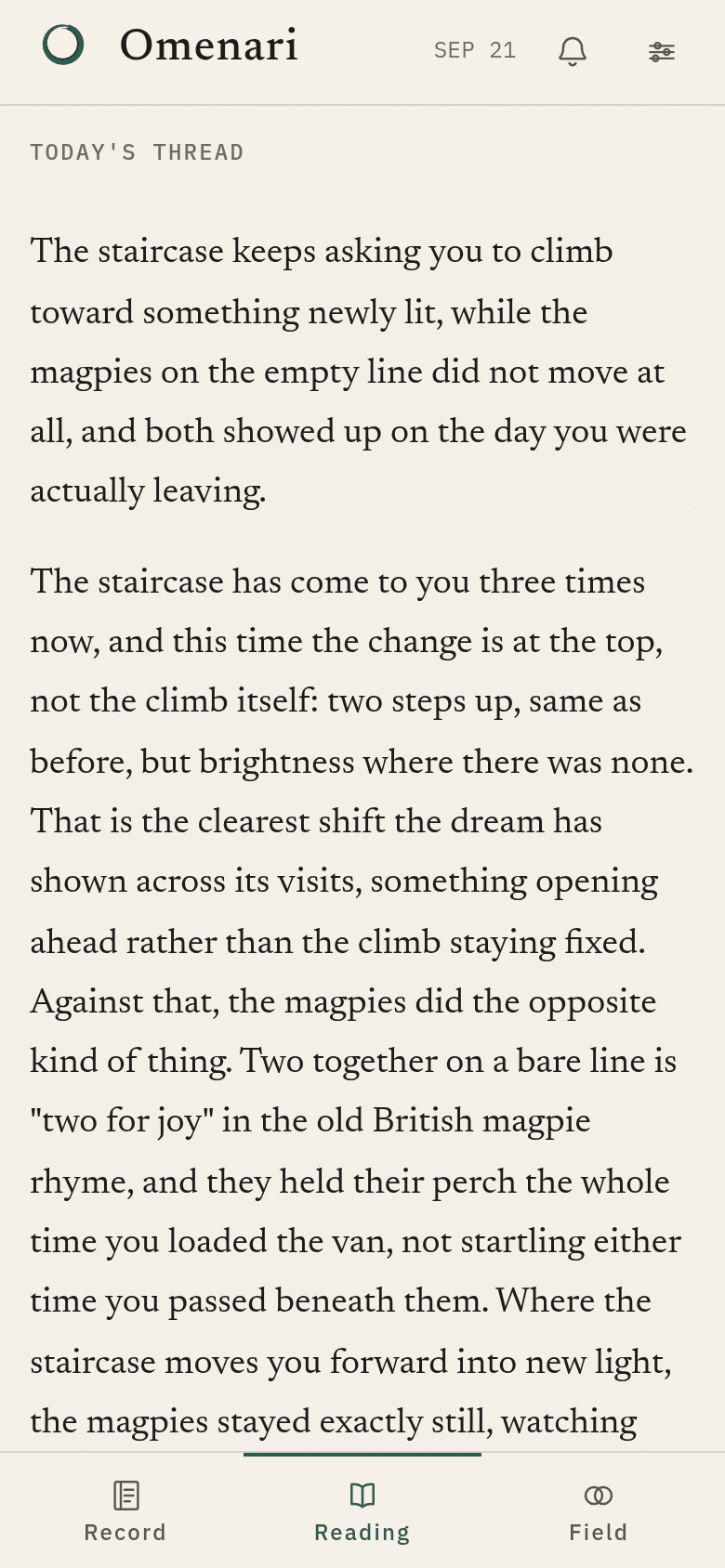
The Thread

The day, read as one piece.

After each symbol is read on its own, the Thread ties the readings together and says what it makes of them, including what it left out and why. It is the one part of a reading that looks across the week.

Example

Two of today’s entries stand at an edge: a dream of a house whose doors all opened onto the same hallway, and three deer that held still at a treeline. Read together, the day keeps returning to a threshold without crossing it. The journal entry about turning down the job sits beside them without being explained by them.

Set aside: the parking ticket, which carried no symbol the rest of the day shares.

Today’s thread in Omenari: a passage of serif prose set directly on the page, with nothing around it.
Pl. IIToday’s thread

What it will not do

It reads symbols, not you.

It reads the thing you saw. It does not diagnose, it does not predict, and it will not tell you what you are avoiding. Where a meaning comes from a tradition, it says which.

It reads the thing you saw
A reading sees one entry and its kind. No other entries, no history, no profile, no dates.
It does not diagnose
It won’t assess you, build a case about you, or tell you what you are avoiding.
It does not predict
It reads what happened. Nothing on a card is a forecast.
You can’t ask it anything
There is no chat and no follow-up. The reading arrives, and what you make of it is yours.

Traditions

A meaning with a source can be checked.

Every card names the tradition its meaning comes from, across 28 families. Tap one in the app to read what it is, and what a claim made in its name is and is not. When nothing matches, the reading says so plainly instead of filling the space.

Some are never read in at all. A closed practice, one taught by initiation inside a living community, is left to that community, and a citation naming one is dropped before it can reach a card.

  • Jungian analysis
  • Norse mythology
  • Islamic dream interpretation
  • Pythagorean numerology
  • The I Ching
  • British and Irish folklore
  • Ancient Egyptian religion
  • Buddhist teaching
  • Tasseography
  • Stoicism
  • Greek myth and religion
  • and more

Every Sunday

The Portrait.

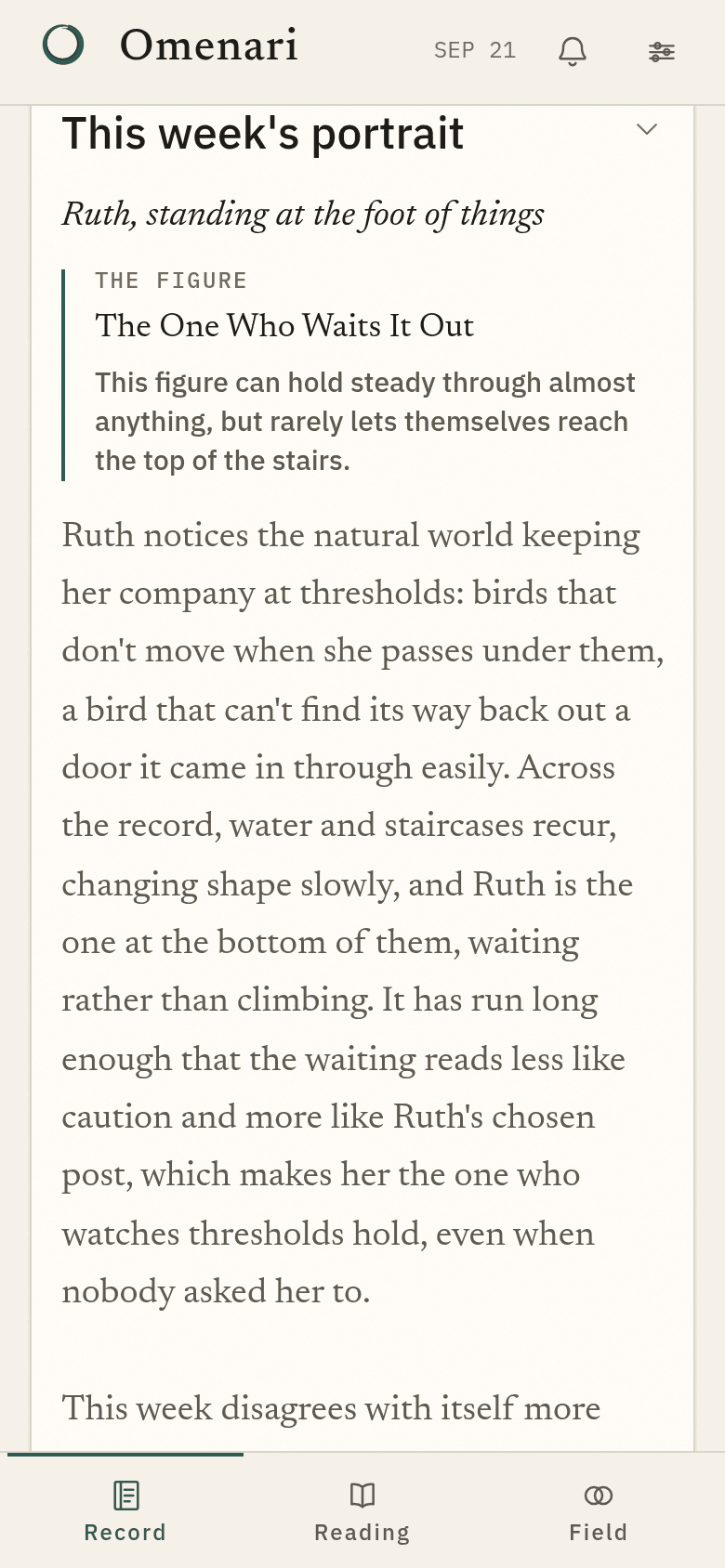
A reading of the person rather than the day, rewritten every Sunday morning. It reads every week you have written, so it moves slowly and gets truer the longer you keep at it. It stays at the level of the shape you make, never the details of what you wrote, because it is the one card the people in your Field can see.

This week’s portraitExample

Someone with a naturalist’s kind of attention: slow to name a thing, and reluctant to let it go once named. Steady rather than sudden, and happiest when something small turns out to mean more than it first seemed.

The Sunday Portrait in Omenari: a short card of serif prose describing the person.
Pl. IIIThe Portrait

The Record

Every day you’ve kept, kept.

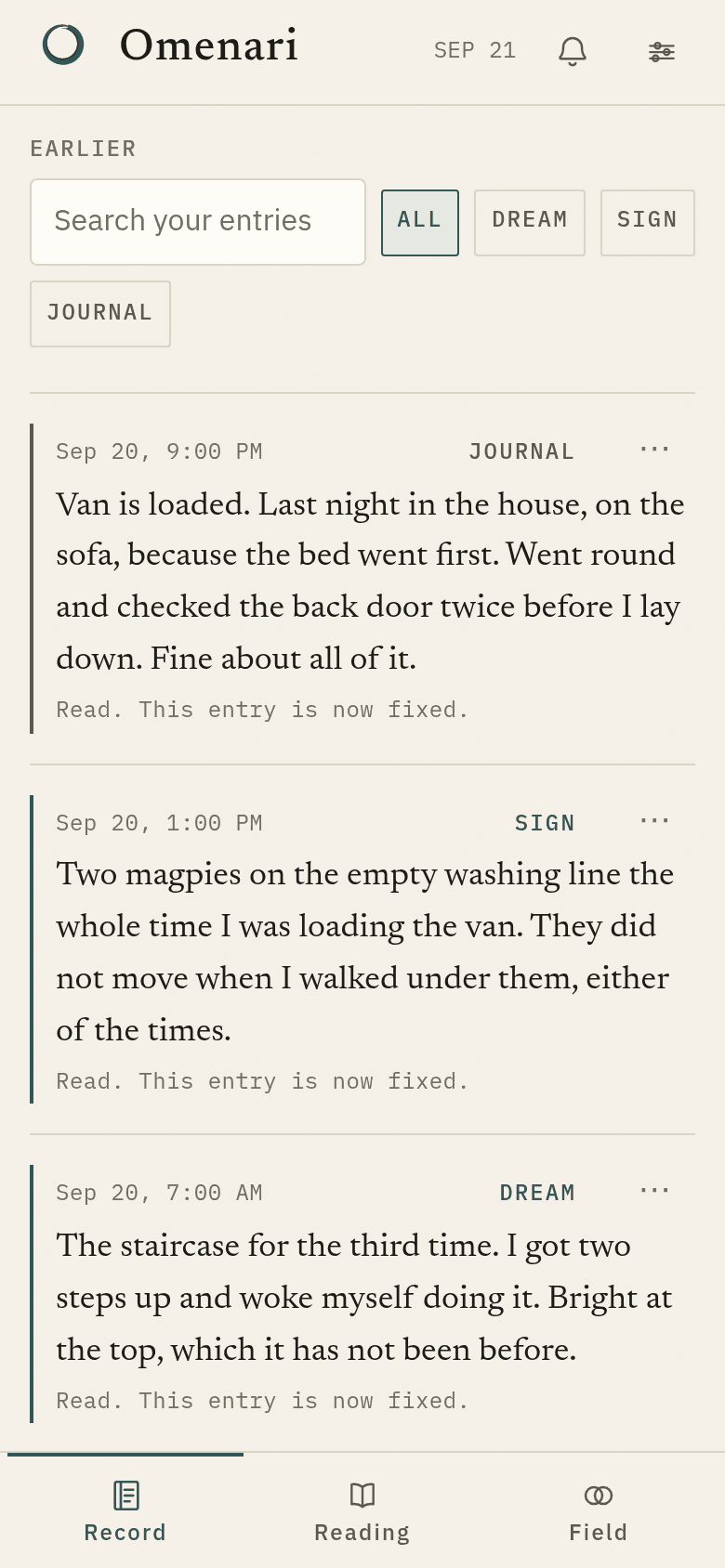
The things you notice are the things you lose. Omenari keeps them: every entry you write, and every reading and thread that comes back, searchable and there to return to whenever you like.

Search your entries
Search everything you’ve written, or filter to just your dreams, signs or journals.
Every day is kept
Readings are never overwritten. Pick any past day and the whole of it comes back: every card, and its thread.
Still there next year
Entries and readings are kept until you delete them, because the point of a journal is that it lasts.
The Record in Omenari: this week’s portrait, a search field with kind filters, and past entries.
Pl. IVThe Record

Privacy

Yours, unless you share it.

Your entries are private by default. Your readings are for your eyes only.

The whole of it is at Privacy, which is the authority; this is the short version.

Private by default
Every entry starts private. You choose, entry by entry, what to share.
Readings stay yours
Your readings are always private to your account, whatever else you share. The only way one leaves is a share card you make yourself.
The Field
Your circle, added by handle. People you accept see the entries you share, your profile and your weekly Portrait, and can react and comment on what you shared.
No tracking
No analytics, no advertising, no tracking pixels, and no third-party cookies. The only cookie is the one that keeps you signed in.
Take it, or leave
Download everything in one file, from Settings. Deleting your account actually deletes it.

Questions

Before you begin.

Something not covered here? Write to hello@omenari.com.

What does Omenari cost?

The journal is free and always will be: writing, searching, your Field, and the export that hands you everything in one file. What costs money is the writing the app does about you, the nightly Reading and the weekly Portrait, at $9.99 a month. The first week is free. Nothing you have written is taken away or deleted by not paying.

How do I sign in?

Sign in with Google, or an email address and a password. Signing in through Google never shows Omenari a password. They confirm it is you and hand back an address, and that is all that is held.

When is my day read?

At 11:59 pm in your own timezone, everything you wrote that day goes to be read. Your readings and the day’s thread are waiting in the morning. Nothing is read the moment you write it, by design.

Where do the meanings come from?

Readings are written by an AI model (Claude, from Anthropic) and attribute every meaning to a named tradition, across 28 families from Jungian analysis to Norse mythology to the I Ching. You can tap through to what that tradition is, and what a claim made in its name is and is not. When a symbol matches no tradition, the reading says so rather than inventing something.

Does every entry get a reading?

Every entry is read. Not every entry holds a symbol, and an entry without one gets no card. That’s a correct result, not a failure.

Is this fortune telling or astrology?

Neither. There is no birth chart and no horoscope. Birth data was collected once, for a feature that has been removed, and nothing reads it. Nothing is predicted. Omenari tells you what a symbol has been held to mean, and by whom.

Are there traditions it won’t read in?

Yes. A closed practice, such as Ifá or Hoodoo or any other taught by initiation inside a living community, is never cited on a card, and a citation naming one is dropped before the card is written. You can still read what the tradition is; the app just will not pretend to read in it.

Can I ask it questions?

No. There is no chat. A reading arrives each morning and a portrait each Sunday, and that is the whole conversation.

Who can see what I write?

Only you, unless you share an entry. People you’ve accepted into your Field see the entries you share, along with your name, handle, photo, bio and weekly Portrait, and can react and comment on what you shared. Your profile also shows how much you’ve written and how many days in a row, never what. Readings stay private to your account.

Can I share a reading?

Not in the app. If you want to post one, Settings can make a share card of the day’s reading with your handle on it. It never includes your entries.

Will it remind me to write?

Only if you want it to. Morning and evening reminders are optional, in Settings.

Can I edit an entry?

Yes, until it has been read. After that, the entry and its reading stay as they were.

Is there an app for iPhone or Android?

Omenari runs in the browser on any phone or computer. On your phone, add it to your home screen and it opens like any other app.

Is Omenari a mental health service?

No. Readings are generated, and are for reflection rather than therapy or medical advice. If you are in crisis in the US, call or text 988.

Write it down. Wake up to what it means.

Begin your record

The first week is free. Your entries stay private by default.